Tree health care in Staunton, VA.
Protect the trees you already have. Disease, pests and poor soil rarely show up overnight. Caught early, many problems can be managed, and a tree that could have been saved does not have to come down.
How can I tell if a tree in my Staunton yard is sick?
Watch for leaves that yellow or drop early, dead branches in the top of the canopy, cracked or oozing bark, small exit holes or sawdust on the trunk, and mushrooms at the base. Staunton Tree Pros takes free requests for tree health checks in Staunton, Augusta County and Waynesboro, Virginia.
Healthy trees don’t happen by accident
Most tree problems develop over months or years. Disease, insects and nutrient shortages usually go unnoticed until real damage has been done, and by the time a big tree looks obviously sick, the options are fewer and more expensive. Catching a problem early is far cheaper than removing a tree that could have been saved.
A tree health check is a careful look at the tree and the ground it grows in: the canopy, the bark, the root zone and the soil. It identifies what is going on, whether it can be treated, and what can be done to give the tree a better chance, from pest treatments to mulching and relief from soil compaction. Shrubs and ornamental plantings can be looked at alongside the trees.
What happens, step by step
A health check is about finding the real cause before deciding on any treatment.
Look and listen
You describe what you have noticed and when it started; the tree and its surroundings are looked over from the roots up.
Find the cause
Symptoms are matched to likely causes, with a soil test or sample where that would settle the question.
Written findings
You get what was found, what can and cannot be done, and the options, including when the honest answer is removal.
Follow-up
Treatments are scheduled for the right season, and trees that need watching can be checked again later.
Valley threats to watch
Several pests and diseases are active in Virginia and worth knowing by name:
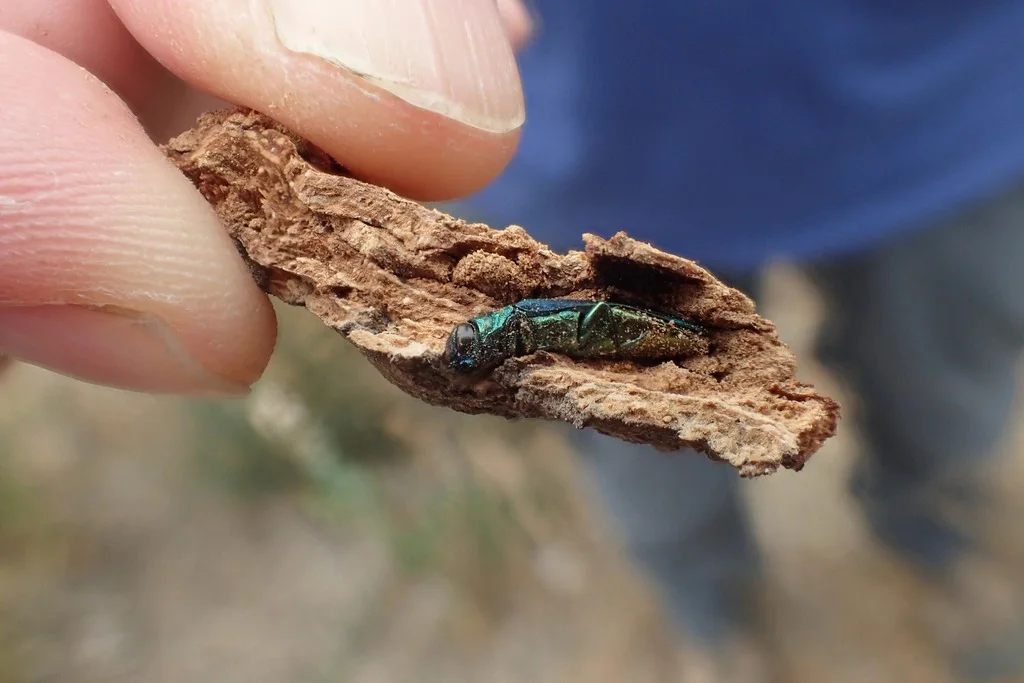
- Emerald ash borer. An invasive beetle that has killed huge numbers of ash trees across North America and has been in Virginia since 2008. Untreated ash trees rarely survive it, but valuable ash trees that are still healthy can be protected with preventive treatment.
- Spotted lanternfly. First found in Virginia in Winchester in 2019 and spreading since. It feeds on many trees and vines, and favors tree of heaven.
- Oak wilt. A fungal disease of oaks, present in Virginia. Red oaks are hit hardest. Avoiding pruning wounds in spring and early summer reduces the risk.
- Hemlock woolly adelgid. A tiny sap-feeding insect that shows up as white woolly tufts on the undersides of hemlock twigs, and can kill trees over several years.
- Thousand cankers disease. A disease of black walnut spread by a small bark beetle, found in Virginia since 2011.
- Anthracnose. A leaf disease common in wet springs on dogwoods, sycamores and maples. Usually cosmetic on big trees, more serious on dogwoods.
Soil, roots and the cost of waiting
A mature tree can take decades to reach its size, and losing one to a problem that early care could have handled is a loss that takes just as long to replace. Much of a tree's health is decided underground. Compacted soil from parking, foot traffic or construction squeezes out the air roots need; grade changes and trenching cut roots that feed the canopy; and nutrient or pH problems slow growth for years before they show.
Soil testing tells you what is actually there instead of guessing. Virginia Cooperative Extension offers soil test kits through its county offices, and test results guide any fertilizer or amendment so the tree gets what it lacks and nothing it does not. A wide ring of mulch over the root zone, kept away from the trunk, is one of the simplest things you can do for a tree.
- Leaves yellowing, browning or dropping early in summer
- Dieback: dead branches in the upper canopy, spreading downward
- Bark cracks, oozing sap or fungus growing on the trunk
- Small holes or sawdust-like frass on the bark, signs of borers
- Thin growth despite enough water
- Wilting that does not recover after rain
Questions people ask
How do I know if my tree is sick?
Common signs include early leaf drop, unusual leaf color, dieback in the top of the canopy, bark problems and visible insects or fungus. If you are unsure, a health check is the most reliable way to find out.
Can a diseased tree be saved?
It depends on the disease, the species and how far it has gone. Many problems can be managed if they are caught early. The findings from a health check should say plainly what is possible and what it would take.
What is the emerald ash borer, and should I be concerned?
It is an invasive beetle that has killed hundreds of millions of ash trees in North America and is present in Virginia. Every ash tree in the Valley is at risk. Healthy, valuable ash trees can be protected with preventive treatment; trees already in decline usually need removing.
Is soil testing part of a health check?
When soil may be part of the problem, yes. Virginia Cooperative Extension offers soil test kits through its county offices, and the results guide any fertilizer or amendment.
A free estimate starts with a few details
Tell us where the tree is and what it is doing. The more you can say about its size, what it stands near and what has changed, the more useful the first conversation is.
- Free estimate, no obligation
- Nothing is scheduled until you have seen the estimate
- Emergency and storm requests are taken